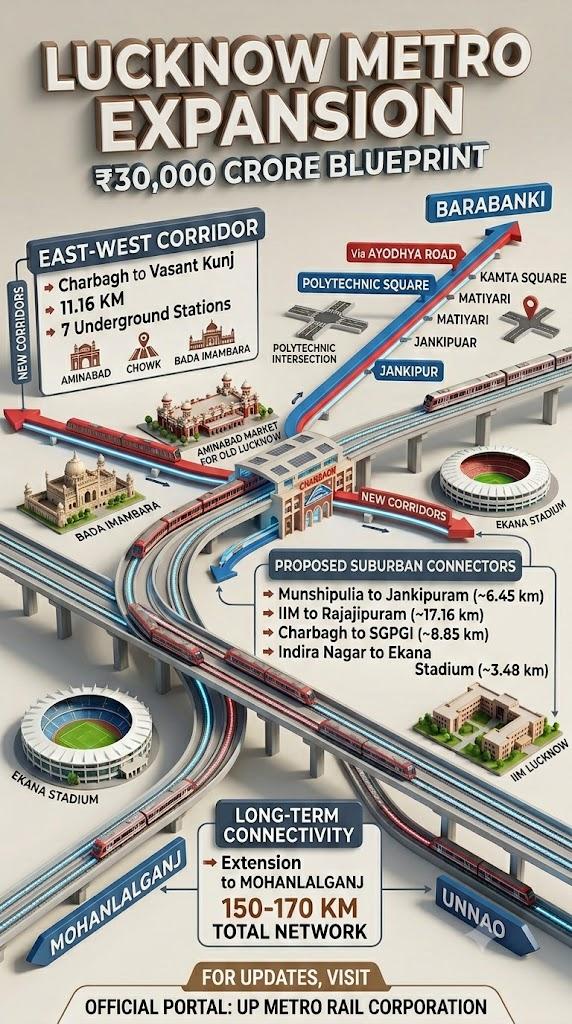
The Mega Expansion Blueprint (Target: 170 km)
The Uttar Pradesh Metro Rail Corporation (UPMRC) has significantly revised its initial plans, scaling up the total proposed network expansion from 93 km to 170 km. This massive ₹30,000 crore vision is designed to seamlessly integrate Lucknow's core urban center with rapidly growing suburban extensions and satellite towns over the next 15 years.
Future Corridors & Satellite Connectivity
Beyond the immediate East-West line, UPMRC and the Lucknow Development Authority (LDA) are mapping out 12 new routes to establish seamless regional connectivity:
- The Barabanki Regional Extension: This major route extends the existing North-South line further toward Barabanki via Ayodhya Road, fundamentally altering the commuter landscape for thousands of daily travelers passing through Polytechnic Square, Kamta Square, and Matiyari.
- Satellite Town Outreach: Long-term survey blueprints include routes stretching to neighboring districts and peripheral hubs like Mohanlalganj and Unnao, transitioning the metro from a city transit system into a wider regional rapid transport network.
- High-Priority Suburban Connectors:
- Munshipulia to Jankipuram (~6.45 km): Bridging major residential zones with upcoming institutional areas.
- IIM to Rajajipuram (~17.16 km): A massive cross-city corridor connecting the northwestern educational hub to the dense residential layouts of Rajajipuram.
- Indira Nagar to Ekana Stadium (~3.48 km): Slated to connect the bustling Gomti Nagar Extension and the capital's premier sports infrastructure zone.
[ जानकीपुरम ]
▲
│ (~6.45 किमी)
│
[ वसंत कुंज ] ◄─── (चौक) ─── [ मुंशीपुलिया ] ════════════► [ बाराबंकी ]
│ │ ▲ (अयोध्या रोड होकर)
│ │ │
(Phase 1B) │ │ (~3.48 किमी)
│ │ │
▼ ▼ ▼
[ राजाजीपुरम ] ◄── [ चारबाग ] ──► [ इकाना स्टेडियम ]
▲ │
│ (~17.16 किमी) │ (~8.85 किमी)
│ ▼
[ IIM ] [ SGPGI ]
│
▼
[ मोहनलालगंज / उन्नाव ]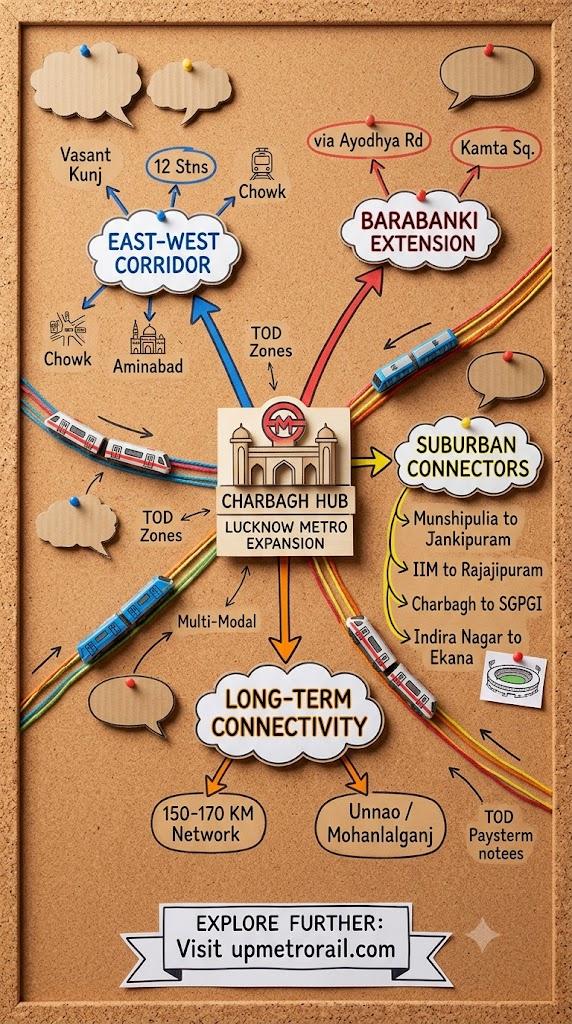
Multimodal Connectivity & Urban Integration
To make the expanded network truly efficient, the future planning centers around Transit-Oriented Development (TOD) and first/last-mile integration:
- Integrated Transport Hubs: Major intersection points like Charbagh will serve as mega-interchanges linking the Northeast-Southwest lines, Indian Railways, and inter-state bus terminals.
- Feeder & E-Vehicle Ecosystems: The upcoming expansion heavily incorporates e-vehicle charging zones, dedicated e-rickshaw docking areas, and organized parking complexes directly at new station nodes to eliminate last-mile commuter friction.
- TOD Zones: The Lucknow Development Authority has delineated specific Transit-Oriented Development zones along these routes in the Lucknow Masterplan, which will promote high-density commercial complexes, retail spaces, and smart residential townships within walking distance of the stations.
Multimodal Connectivity & Urban Integration
To make the expanded network truly efficient, the future planning centers around Transit-Oriented Development (TOD) and first/last-mile integration:
- Integrated Transport Hubs: Major intersection points like Charbagh will serve as mega-interchanges linking the Northeast-Southwest lines, Indian Railways, and inter-state bus terminals.
- Feeder & E-Vehicle Ecosystems: The upcoming expansion heavily incorporates e-vehicle charging zones, dedicated e-rickshaw docking areas, and organized parking complexes directly at new station nodes to eliminate last-mile commuter friction.
- TOD Zones: The Lucknow Development Authority has delineated specific Transit-Oriented Development zones along these routes in the Lucknow Masterplan, which will promote high-density commercial complexes, retail spaces, and smart residential townships within walking distance of the stations.
- The Mega Expansion Blueprint (Target: 170 km)
- The Uttar Pradesh Metro Rail Corporation (UPMRC) has significantly revised its initial plans, scaling up the total proposed network expansion from 93 km to 170 km. This massive ₹30,000 crore vision is designed to seamlessly integrate Lucknow's core urban center with rapidly growing suburban extensions and satellite towns over the next 15 years.
- Future Corridors & Satellite Connectivity
- Beyond the immediate East-West line, UPMRC and the Lucknow Development Authority (LDA) are mapping out 12 new routes to establish seamless regional connectivity:
- The Barabanki Regional Extension:This major route extends the existing North-South line further toward .Barabanki via Ayodhya Road, fundamentally altering the commuter landscape for thousands of daily travelers passing through Polytechnic Square, Kamta Square, and Matiyari.
Satellite Town Outreach: Long-term survey blueprints include routes stretching to neighboring districts and peripheral hubs like Mohanlalganj and Unnao , transitioning the metro from a city transit system into a wider regional rapid transport network.
High-Priority Suburban Connectors
Munshipulia to Jankipuram (~6.45 km). Bridging major residential zones with upcoming institutional areas.
* **IIM to Rajajipuram (~17.16 km):A massive cross-city corridor connecting the northwestern educational hub to the dense residential layouts of Rajajipuram.
* **Indira Nagar to Ekana Stadium (~3.48 km): Slated to connect the bustling Gomti Nagar Extension and the capital's premier sports infrastructure zone. - Multimodal Connectivity & Urban Integration
- To make the expanded network truly efficient, the future planning centers around .Transit-Oriented Development (TOD)and first/last-mile integration:
- Integrated Transport Hubs.Major intersection points like Charbagh will serve as mega-interchanges linking the Northeast-Southwest lines, Indian Railways, and inter-state bus terminals.
Feeder & E-Vehicle Ecosystems:The upcoming expansion heavily incorporates e-vehicle charging zones, dedicated e-rickshaw docking areas, and organized parking complexes directly at new station nodes to eliminate last-mile commuter friction.
* The [Lucknow Development Authority](https://ldalucknow.in) has delineated specific Transit-Oriented Development zones along these routes in the Lucknow Masterplan, which will promote high-density commercial complexes, retail spaces, and smart residential townships within walking distance of the stations. - The expansion of the Lucknow Metro network into a 170-km regional rapid transit system** is set to be a massive catalyst for economic growth, fundamentally transforming the employment landscape of peripheral and regional areas like Barabanki, Mohanlalganj, and Unnao
- Here is how this infrastructure boom will drive future development and employment in these regional hubs.
- Direct Job Creation in Construction and Operations
- The scale of a ₹30,000crore project guarantees a massive influx of jobs over the next decade:
- Phase 1 & 2 Construction: Thousands of opportunities for civil engineers, technicians, heavy machinery operators, and skilled/unskilled labor as new tracks, elevated corridors, and underground tunnels are built.
Operational Workforce: Long-term employment for metro station staff, security personnel, maintenance engineers, and administrative roles once the routes become operational. - Industrial and Commercial Decentralization
- Currently, major employment hubs are concentrated within Lucknow’s core (like Gomti Nagar or Hazratganj). High-speed connectivity will shift this dynamic:
- New Business Hubs:The introduction of Transit-Oriented Development (TOD) zones will incentivize companies to build commercial complexes and corporate offices near regional stations where land values are more affordable.
Boost to Manufacturing & Logistics:Areas like Unnao (already known for industrial clusters) and regions along Ayodhya Road toward Barabanki will see a surge in warehousing, manufacturing plants, and logistics hubs due to seamless connectivity back into the capital. - Real Estate and Suburb Growth
- As connectivity improves, regional areas will rapidly evolve from rural outskirts into bustling suburban townships:
- Construction Boom: Massive demand for housing, apartments, and commercial complexes near regional stations will generate continuous local employment in the real estate sector.
Appreciation of Local Trade. Local retail shops, complexes, and service sectors will thrive due to increased footfall and higher population densities in these newly developed areas.
Related posts:
The development of the Lucknow State Capital Region (SCR) and the proposed 250-km, six-lane Vigyan Path corridor is set to redefine the growth landscape of Lucknow and its surrounding districts. This mega infrastructure project is driving land value appreciation, attracting...
A major ₹720 crore development project is set to transform the area around Lucknow Airport. The project includes modern 3-star and 4-star hotels along with a state-of-the-art convention center under the Public-Private Partnership (PPP) model. It is expected to boost...
 Barabanki: The Next Growth Hub of Uttar Pradesh | SCR to Transform the Future
 Property Measurement Guide Part 2: Acre, Hectare, Bigha, Biswa और भारत की Land Measurement Units
 Kattha, Dhur, Marla, Kanal, Guntha, Decimal और Cent – भारत की प्रमुख Land Measurement Units की पूरी जानकारी
 Property Measurement में होने वाली सामान्य गलतियाँ, Expert Tips, FAQ और निष्कर्ष
 Vigyan Path & Lucknow SCR: The ₹10,000 Crore Mega Development Transforming Lucknow's Real Estate Future